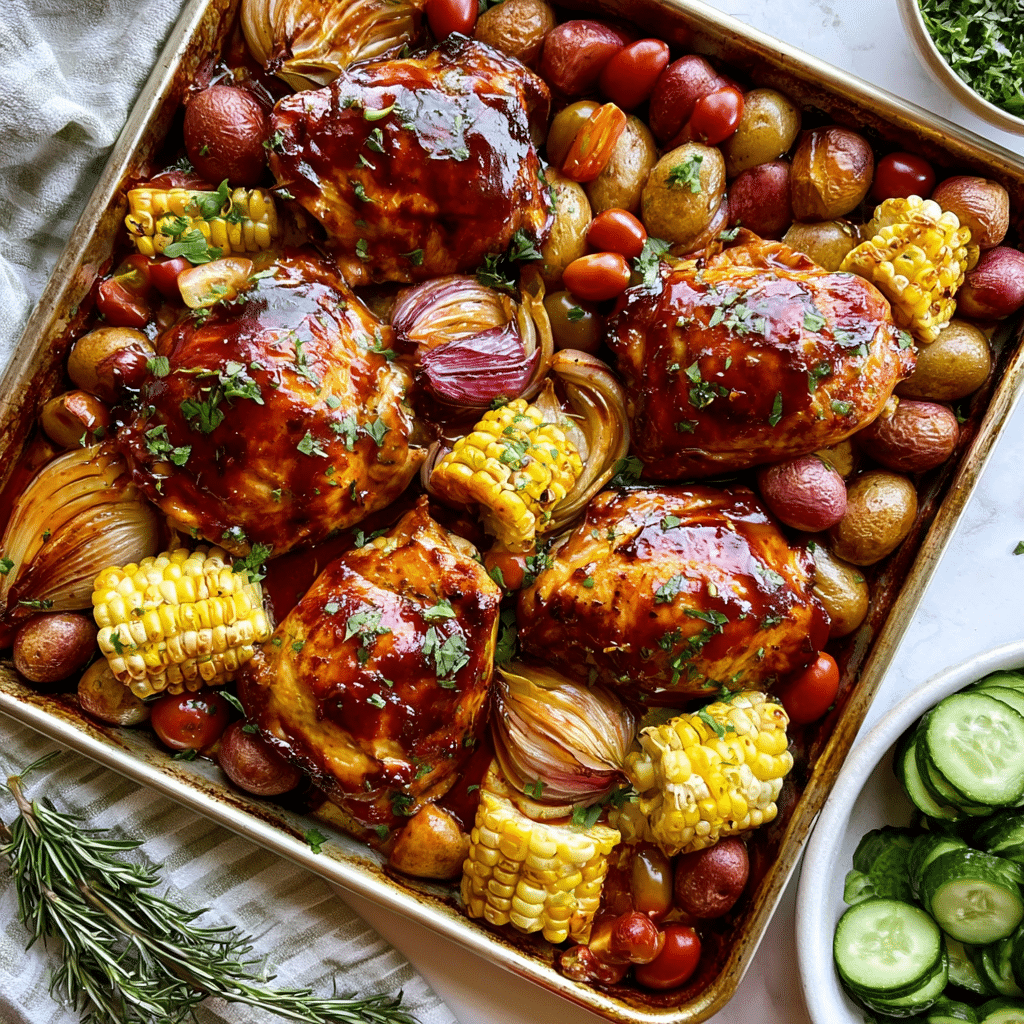
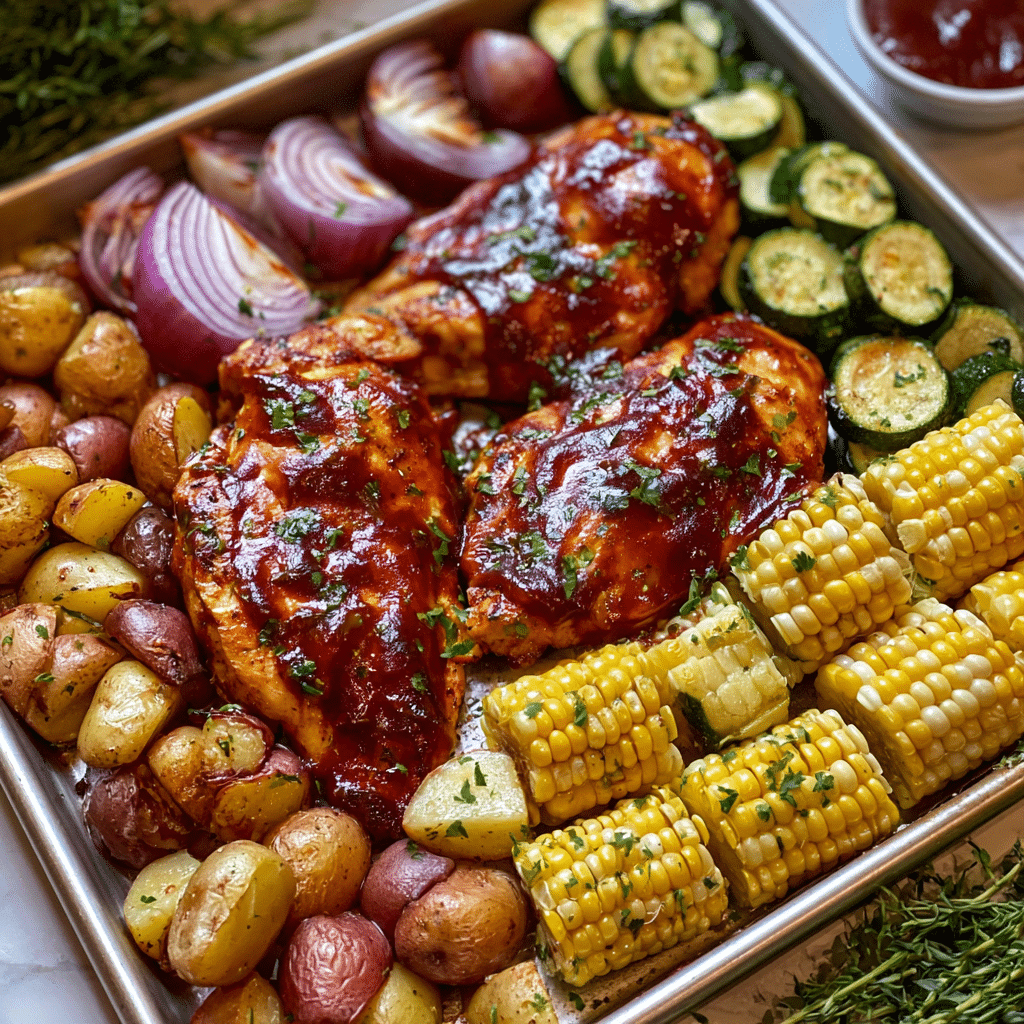
BBQ Chicken Sheet Pan is a complete summer-style dinner of pounded chicken breasts glazed in two coats of barbecue sauce, roasted alongside baby potatoes, corn on the cob, zucchini, and red onion on a single pan at 400°F. The two-stage glazing method builds a deep, sticky barbecue crust on the chicken while the vegetables caramelize slowly over 55 minutes into something that tastes like a backyard cookout without the grill.
Why You’ll Love This Recipe
The two-stage barbecue glazing — half the sauce before roasting, the remaining half brushed on in the final 5 minutes — builds a deeply caramelized, sticky crust that no single application can produce. The second coat goes on hot and sets into a rich, glossy layer that locks the smoky-sweet barbecue flavor directly onto the surface of every breast.
This recipe delivers every flavor of a backyard summer cookout — smoky glazed chicken, slightly charred corn, tender potatoes, and caramelized onion — without the grill, the charcoal, or the unpredictable weather. It produces a cookout-caliber meal from a standard home oven in any season.
One bowl for the vegetables, one pan for everything — pounding and seasoning the chicken takes 5 minutes, and the rest is completely hands-off roasting time. Nothing to flip, stir, or monitor between the first and second glaze application.
The corn sections, baby potatoes, zucchini, and red onion bring enough variety and vivid color to the pan that every person at the table finds something to reach for. Four chicken breasts cover the whole family without any portioning math.
At 55 minutes total cook time with only 15 minutes of active prep, the time investment is minimal relative to the complete, satisfying cookout-style meal it produces — and almost all of that time is hands-free.
Ingredient List
For the Chicken:
- 4 boneless, skinless chicken breasts (about 2 pounds), pounded to an even thickness
- 1 teaspoon kosher salt
- ½ teaspoon black pepper
- ½ cup barbecue sauce, divided
For the Vegetables:
- 1 pound baby potatoes, halved lengthwise
- 1 large red onion, halved and sliced into ¼-inch half-moons
- 1 medium zucchini, halved lengthwise and sliced into ¼-inch half-moons
- 4 ears corn, husked and cut into 2-inch sections
- 2 tablespoons extra virgin olive oil
- 1 teaspoon kosher salt
- 1 teaspoon garlic powder
- 1 teaspoon onion powder
- ½ teaspoon paprika
For Garnish:
- Fresh parsley, chopped
Why These Ingredients Work
Chicken breasts pounded to an even thickness solve the single most common problem with roasting whole chicken breasts — the natural taper from a thick center to a thin tip. In a 55-minute roast, the thin tip dries out and overcooks long before the thick center reaches temperature. Pounding to a uniform ¾-inch thickness means every part of every breast reaches 165°F at the same time, producing consistently juicy, evenly cooked chicken across the full surface area.
The two-stage barbecue sauce application is the technique that separates this recipe from a standard sheet pan chicken. The first coat — applied before the oven — caramelizes deeply into the surface of the chicken over the long initial roast, building a sticky, cooked-in layer of flavor that becomes part of the meat rather than sitting on top of it. The second coat, brushed on in the final 5 minutes over an already hot surface, sets into a bright, glossy finishing layer that gives the chicken its visual appeal and its concentrated barbecue punch.
Corn cut into 2-inch sections roasts at the same rate as the baby potatoes over the full 55-minute cook time, making them the most compatible vegetable pairing in this recipe. At 2 inches, each section has enough mass to stay juicy at the center while developing a lightly caramelized, slightly charred exterior on the cut faces. They also absorb the seasoned olive oil and the paprika coating as they roast, delivering far more flavor than plain steamed corn would.
Baby potatoes halved lengthwise are the structural anchor of the vegetable side. Their cut face sits against the hot parchment and develops a caramelized, slightly crispy bottom crust over 55 minutes, while the skin side stays intact and the interior cooks to a creamy, fluffy finish. At this size, they need the full roasting time — they are the densest item on the pan and the primary reason the total cook time runs longer than most sheet pan recipes.
Essential Tools and Equipment
- Large baking sheet (18×13 inches)
- Parchment paper
- Large mixing bowl
- Meat mallet or heavy skillet for pounding the chicken
- Pastry brush for applying the barbecue sauce
- Sharp chef’s knife and cutting board
- Instant-read meat thermometer
- Paper towels for patting the chicken dry
How To Make BBQ Chicken Sheet Pan
Phase 1: Prep and Season the Chicken
- Preheat the oven to 400°F (200°C) and line a large baking sheet with parchment paper.
- Pat the chicken breasts completely dry with paper towels, then season both sides evenly with the kosher salt and black pepper.
- Brush the chicken on both sides with half of the barbecue sauce, coating every surface evenly. Reserve the remaining half of the sauce for later.
- Place the chicken on one side of the prepared sheet pan, leaving space between each breast.
Phase 2: Season and Arrange the Vegetables
- Combine the halved baby potatoes, sliced red onion, sliced zucchini, and corn sections in a large bowl. Add the olive oil, kosher salt, garlic powder, onion powder, and paprika. Toss until every piece is evenly coated.
- Arrange the seasoned vegetables around the chicken in a single, even layer.
Phase 3: First Roast
- Bake for 50 minutes, until the vegetables are tender and the chicken is nearly cooked through.
Phase 4: Apply the Second Glaze and Finish
- Remove the pan from the oven and brush the chicken with the remaining barbecue sauce.
- Return the sheet pan to the oven and bake for an additional 5 minutes, until the chicken reaches an internal temperature of 165°F (74°C) and the potatoes are fork-tender.
- Garnish with chopped fresh parsley and serve immediately.
Chef Tips for Perfect Results
- Pound the chicken to a uniform ¾-inch thickness before anything else — this single step eliminates dry edges, undercooked centers, and uneven cooking across different-sized breasts; it is the most impactful technique in the entire recipe.
- Pat the chicken completely dry before seasoning — surface moisture dilutes the salt and prevents the barbecue sauce from bonding directly to the meat surface during roasting.
- Place the cut face of the baby potatoes face-down on the pan — the flat cut surface in direct contact with the hot parchment builds the caramelized, slightly crispy crust that makes roasted potatoes worth eating.
- Keep the vegetables in a strict single layer — stacked or overlapping pieces trap steam and produce braised, soft vegetables rather than caramelized, roasted ones.
- Choose your barbecue sauce intentionally — smoky, sweet, spicy, and vinegar-forward styles each produce a different finished dish; the sauce is the primary flavor driver, so use one you genuinely enjoy.
- Broil for 2–3 minutes after the second glaze for a deeper, more caramelized BBQ crust that more closely replicates the char of an outdoor grill.
You Must Know
Pounding the chicken to an even thickness is not optional for this recipe. The 55-minute total cook time is driven by the baby potatoes and corn, which are the densest items on the pan. A whole, unflattened chicken breast left to roast for 55 minutes will produce overcooked, dry meat across the entire surface. Pounding to uniform thickness ensures the chicken reaches 165°F at the correct moment — not 20 minutes before the potatoes are done.
The vegetables need every one of the initial 50 minutes before the second BBQ glaze goes on the chicken. Baby potatoes require significant oven time to cook through completely and develop a caramelized exterior. Do not attempt to speed the process by increasing the oven temperature — a higher heat produces charred barbecue sauce and raw potato centers simultaneously. The timing in this recipe is calibrated specifically for 400°F across all components.
Pro Tips & Cooking Hacks
- Add 1 tablespoon of honey to the barbecue sauce before applying both coats for a stickier, more caramelized crust that develops a deeper mahogany color in the oven.
- Tent the chicken loosely with foil for the first 30 minutes if using a sweet barbecue sauce with high sugar content — it prevents the sauce from darkening excessively before the chicken cooks through.
- Add a splash of apple cider vinegar to the reserved barbecue sauce before the second application for a tangier, sharper final glaze that cuts through the richness of the potatoes.
- Add zucchini only in the final 20 minutes if you prefer firmer, less softened zucchini — at ¼-inch slices, zucchini softens significantly over the full 55-minute roast.
- Substitute 2 cups of frozen corn kernels for the fresh corn ears if out of season — add them in the final 15 minutes rather than from the start, as they require less roasting time than 2-inch corn sections.
- Use the same parchment paper trick for easy cleanup — the caramelized barbecue sauce bonds aggressively to bare metal but lifts off parchment completely, saving significant scrubbing time.
Flavor Variations & Suggestions
Honey BBQ chicken: Stir 2 tablespoons of honey into the full ½ cup of barbecue sauce before dividing it into two portions. The extra honey produces a sweeter, stickier glaze that caramelizes to a deep, glossy mahogany color on the chicken surface and adds a noticeable sweetness that balances the savory vegetables.
Spicy BBQ chipotle: Add 1 tablespoon of blended chipotle in adobo sauce to the barbecue sauce before applying. The chipotle adds a smoky, slow-building heat and a deep, complex spice note that transforms the familiar BBQ flavor into something significantly more assertive and layered.
Alabama white BBQ: Swap the tomato-based barbecue sauce for an Alabama white barbecue sauce — equal parts mayonnaise, apple cider vinegar, horseradish, and a pinch of black pepper. The white sauce produces a tangy, creamy, peppery finish on the chicken that pairs especially well with the corn and potatoes.
Sweet potato BBQ: Replace the baby potatoes with an equal weight of cubed sweet potato cut into 1-inch pieces. Sweet potato roasts in the same 50-minute window and adds a natural, caramelized sweetness that complements the smoky-sweet barbecue glaze with a deeper, more complex vegetable base.
Make-Ahead Options
Glazed chicken: Season and brush the chicken with the first coat of barbecue sauce up to 24 hours in advance, cover tightly, and refrigerate. The sauce penetrates the surface of the meat overnight and produces a noticeably deeper, more caramelized result when roasted. Keep the reserved second coat separate in a sealed jar.
Seasoned vegetables: Toss the potatoes, red onion, zucchini, and corn with the olive oil and seasonings up to 24 hours in advance and store in an airtight container in the refrigerator. Bring to room temperature for 10 minutes before spreading on the pan.
Custom barbecue sauce blend: If using a homemade or doctored barbecue sauce (with honey, vinegar, or chipotle), mix it up to 5 days in advance and store in a sealed jar in the refrigerator. The flavors meld as it sits and produce a more cohesive, complex sauce than a freshly mixed batch.
Freezing cooked chicken: Store fully cooked, cooled chicken in a freezer-safe container for up to 2 months. The barbecue glaze holds up well through freezing and reheating. Freeze the roasted vegetables separately — corn and zucchini change texture significantly after freezing, while the potatoes and onion reheat more consistently.
Recipe Notes & Baker’s Tips
- The character of this dish is entirely determined by the barbecue sauce you choose — smoky, sweet, spicy, and tangy regional styles all produce a completely different finished dish from the same recipe; use a sauce you genuinely enjoy.
- Parchment paper is essential, not optional — the caramelized barbecue sauce bonds to bare sheet pan metal and requires serious effort to remove; parchment eliminates the problem entirely.
- Four ears of corn produce 12–16 sections at 2 inches each; if corn is not a priority for your household, reduce to 2 ears and increase the potato quantity to fill the pan.
- Zucchini at ¼-inch slices softens considerably over 55 minutes — this is intentional for a fully tender vegetable side; if you want firmer zucchini, add it only in the final 20 minutes of the initial 50-minute roast.
- The recipe is calibrated for 4 large chicken breasts at about 8 ounces each before pounding; if your breasts are smaller (5–6 ounces), reduce the first roast to 40 minutes and check internal temperature at 35 minutes.
Serving Suggestions
Extra barbecue sauce for dipping: Set out a small bowl of warmed barbecue sauce alongside the plated chicken — it doubles as a dipping sauce for the roasted potatoes and corn sections and reinforces the flavor of the glaze with every bite of vegetable.
Classic coleslaw: A bowl of creamy or vinegar-based coleslaw provides a cool, crunchy contrast to the warm, caramelized vegetables and the sticky barbecue glaze. The acidity of the coleslaw dressing cuts through the richness of the BBQ chicken in exactly the way a side dish should.
Warm cornbread or buttered rolls: Serve with warm cornbread or soft dinner rolls for mopping up the caramelized barbecue pan drippings — everything that pools under the chicken on that parchment is deeply flavored and should not go to waste.
Cold lemonade or a chilled pale ale: A glass of fresh lemonade mirrors the sweet-tart balance of the barbecue glaze and provides a refreshing, citrusy contrast to the smoky chicken. A chilled pale ale with its hoppy bitterness cuts cleanly through the sticky BBQ crust and complements the charred edges of the corn.
Storage & Reheating
- Refrigerator: Store leftovers in an airtight container for up to 4 days; the barbecue glaze firms up in the cold but softens again during reheating.
- Oven reheating (recommended): Reheat at 375°F for 12–15 minutes — this re-crisps the potato edges and restores some of the sticky, caramelized texture to the barbecue glaze on the chicken surface.
- Freezer: Freeze cooked chicken in a sealed container for up to 2 months; freeze potatoes and onion separately; avoid freezing corn and zucchini, as both lose their texture after freezing and reheating.
Allergy Information
Gluten: Most commercial barbecue sauces contain gluten via Worcestershire sauce or soy sauce in the ingredient list. Verify the label of your chosen sauce for a gluten-free certification or use a dedicated gluten-free barbecue sauce — all other ingredients in this recipe are naturally gluten-free.
Nightshade sensitivity: Paprika, zucchini, and most tomato-based barbecue sauces are nightshades. Replace the paprika with ground turmeric for color and warmth, substitute zucchini with yellow squash or mushrooms, and choose a nightshade-free barbecue sauce alternative such as an apple-cider-vinegar-and-mustard base.
Low-sodium needs: The recipe uses 2 teaspoons of kosher salt across the full batch plus significant sodium from the commercial barbecue sauce. Reduce the total kosher salt to ½ teaspoon, choose a low-sodium or homemade barbecue sauce, and the overall sodium per serving drops substantially without losing the core BBQ flavor profile.
Questions I Get Asked A Lot
Why does the second coat of barbecue sauce go on only in the last 5 minutes?
The first coat needs the full 50 minutes to caramelize into the chicken surface; applying the second coat in the final 5 minutes prevents it from burning and ensures it sets into a bright, fresh, glossy finishing layer rather than darkening and charring alongside the first coat.
Can I use chicken thighs instead of breasts?
Yes, boneless skinless chicken thighs need no pounding and stay juicier throughout the 55-minute roast — place them smooth-side up, apply the two-stage barbecue glaze the same way, and check for 165°F at the 40-minute mark since thighs may finish slightly earlier than pounded breasts.
Can I use frozen corn instead of fresh corn on the cob?
Yes, substitute 2 cups of frozen corn kernels for the fresh corn sections — add them in the final 15 minutes of the initial 50-minute roast rather than from the beginning, as frozen kernels require significantly less roasting time than 2-inch fresh corn sections.
My zucchini always turns mushy — how do I prevent that?
Zucchini at ¼-inch slices softens significantly over 55 minutes of roasting — add it only during the final 20 minutes of the initial 50-minute roast rather than from the start, and it will come out tender-crisp rather than fully softened.
Can I swap out any of the vegetables for something else?
Yes — bell peppers, asparagus, green beans, and red potatoes all work well in this recipe; add dense vegetables like bell peppers and red potatoes from the start, and add delicate ones like asparagus and green beans in the final 15–20 minutes to prevent overcooking.
💬 Tried this recipe? Leave a comment and rating below!
Print
BBQ Chicken Sheet Pan
- Total Time: 70 minutes
- Yield: 4 servings
- Diet: Gluten Free
Description
BBQ Chicken Sheet Pan is a complete summer-style dinner of pounded chicken breasts glazed in two coats of barbecue sauce, roasted alongside baby potatoes, corn on the cob, zucchini, and red onion on a single pan at 400°F.
Ingredients
4 boneless, skinless chicken breasts (about 2 pounds), pounded to an even thickness
1 teaspoon kosher salt (for the chicken)
½ teaspoon black pepper (for the chicken)
½ cup barbecue sauce, divided
1 pound baby potatoes, halved lengthwise
1 large red onion, halved and sliced into ¼-inch half-moons
1 medium zucchini, halved lengthwise and sliced into ¼-inch half-moons
4 ears corn, husked and cut into 2-inch sections
2 tablespoons extra virgin olive oil
1 teaspoon kosher salt (for the vegetables)
1 teaspoon garlic powder
1 teaspoon onion powder
½ teaspoon paprika
Fresh parsley, chopped (for garnish)
Instructions
1. Preheat the oven to 400°F (200°C) and line a large baking sheet with parchment paper.
2. Pat the chicken breasts completely dry with paper towels and season both sides with the kosher salt and black pepper.
3. Brush the chicken on both sides with half of the barbecue sauce, coating every surface evenly. Reserve the remaining half of the sauce for the final glaze.
4. Place the chicken on one side of the prepared sheet pan, leaving space between each breast.
5. Combine the halved baby potatoes, sliced red onion, sliced zucchini, and corn sections in a large bowl. Add the olive oil, kosher salt, garlic powder, onion powder, and paprika. Toss until every piece is evenly coated.
6. Arrange the seasoned vegetables around the chicken in a single, even layer.
7. Bake for 50 minutes, until the vegetables are tender and the chicken is nearly cooked through.
8. Remove the pan from the oven and brush the chicken with the remaining barbecue sauce.
9. Return the sheet pan to the oven and bake for an additional 5 minutes, until the chicken reaches an internal temperature of 165°F (74°C) and the potatoes are fork-tender.
10. Garnish with chopped fresh parsley and serve immediately.
Notes
Pound the chicken to a uniform ¾-inch thickness before seasoning — unflattened chicken breasts taper from a thick center to a thin tip and produce overcooked edges and undercooked centers over a 55-minute roast; even thickness solves both problems simultaneously.
The second coat of barbecue sauce goes on in the final 5 minutes only — the first coat needs the full 50-minute roast to caramelize into the surface; applying the second coat too early causes it to char and burn before the potatoes are done.
Place baby potatoes cut-face-down on the parchment — the flat cut surface in direct contact with the hot pan builds the caramelized bottom crust that makes roasted potatoes worth eating.
Parchment paper is essential for this recipe — the caramelized barbecue sauce bonds aggressively to bare metal and is very difficult to remove; parchment lifts cleanly with zero scrubbing.
Add zucchini only in the final 20 minutes of the initial roast if you prefer firmer zucchini — at ¼-inch slices it softens significantly over the full 50 minutes, which is intentional but adjustable.
| Storage method | Duration | Reheating instructions |
|---|---|---|
| Refrigerator | Up to 4 days | Reheat at 375°F for 12–15 minutes to re-crisp the potatoes and restore the sticky texture of the barbecue glaze |
| Freezer (chicken only) | Up to 2 months | Thaw overnight in the refrigerator; reheat at 375°F for 15 minutes. Avoid freezing corn and zucchini — both lose texture after freezing. |
| Microwave | Use within 4 days | Reheat in 60-second intervals on medium power — oven reheating produces significantly better texture for the potatoes and the barbecue glaze |
- Prep Time: 15 minutes
- Cook Time: 55 minutes
- Category: Dinner
- Method: Baking
- Cuisine: American